Translating Beatrix Potter’s classic Farmyard Tale
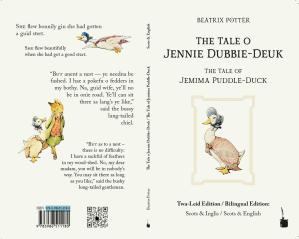 The rural setting and classic style of Beatrix Potter’s tale of the hapless Jemima Puddle-Duck makes it a natural candidate for translation into Scots. The Scots language has no shortage of farmyard vocabulary, and several key terms in the story have long-standing equivalents in Scots, such as deuk and deukies for ‘a duck’ and her ‘ducklings’, tod for ‘a fox’ and cleckin for ‘hatching’. Although the word puddle-duck existed in English before Beatrix Potter made it famous, there was no direct equivalent in Scots, so I had to invent one, basing it on the Scots word dub for ‘a pond’ or ‘puddle’. There is even a kailyard (kitchen garden) in the story, where Jemima picks dunches of herbs – so in that sense it may even be called a modern Kailyard tale!
Jennie Dubbie-Deuk is not the first Beatrix Potter character to speak Scots. Peter Rabbit first appeared as Peter Kinnen in 2004, in a Scots translation by Lynne McGeachie, who has also written a very interesting book about Beatrix Potter’s connections with Scotland, and the family holidays in Perthshire which inspired her art (Beatrix Potter’s Scotland, Luath, 2010).
I often look at translations in other languages to see what decisions my fellow translators have made about a particular text. Have they retained the original character names or replaced them with equivalents in their own language? How have they dealt with the linguistic challenges of idioms or onomatopoeia? Before I began, I was interested to read that Beatrix Potter was herself keen for translators to have some artistic leeway in translating her work. Several of her titles were translated during her lifetime and, as a fluent French speaker, she was particularly interested in the translations into that language. ‘I like the French translations,’ she wrote in 1921, ‘it is like reading some one else’s work—refreshing.’ (Beatrix Potter’s Letters, ed. J. Taylor, 1989) From the outset, Potter was keen that the French versions should be as idiomatic as possible, even if this meant substantial changes to her original text. At one point she urged the translators: ‘Please—do not try to keep so near the English words—it only spoils the French.’
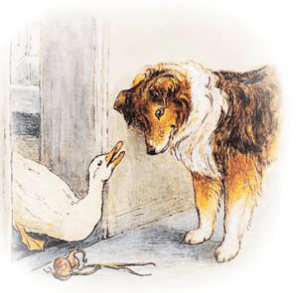 For Jemima, the French translators decided to call Beatrix Potter’s heroine, Sophie Canétang, but to retain the original name for her sister-in-law, Rebecca. In Gaelic, Jemima becomes Simeig Tunnag-Lòin and her sister-in-law is Beathag. Perhaps my favourite is the wonderfully onomatopoeic name in Dutch, where she becomes Kwakkel Waggel–Eend! Taking a cue from Potter’s encouragement to localise the text, I named the Scots heroine Jennie and her guid-sister (sister-in-law) is Peggie — in an unashamed nod to the female leads in Allan Ramsay’s pastoral masterpiece, The Gentle Shepherd (1725). Both French and Gaelic – and my own Scots translation – retain Kep as the name of the collie. It was after all the name of Potter’s own beloved collie, so it seems almost sacrilegious to change it, and it works as well in Scots as in other languages. The word collie itself needs no translation and has been used to denote a Scottish shepherd’s dog since the 17th century. One of the canine characters in Robert Burns’ poem The Twa Dogs is ‘a ploughman’s collie’ called Luath, whose ‘breast was white, his tousie back Weel clad wi’ coat o’ glossy black’.
Tods and Tod-snowkers
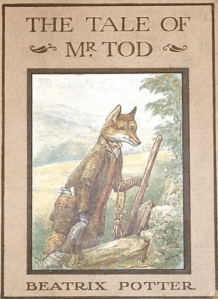 The crafty ‘fox-like gentleman’ in Jemima translates happily into Scots as a tod-like chiel, and his ‘earth’ becomes a tod-hole. Foxes have been called tods in both Scots and Northern English since the 12th century. (There is no relation incidentally to whisky toddies, which although they may be as amber-coloured as a tod, derive their name from Hindi rather than Scots.) Beatrix Potter sometimes used dialect words for naming her characters, and one of her later stories features a fox called Mr Tod and a badger Tommy Brock. Like tod, the word brock for ‘badger’ was used in both Scots and Northern English and Potter may have heard either term used in Cumbria, where she lived for most of her adult life, as well as in Perthshire where she spent childhood holidays. As there was no specific word in Scots for ‘a foxhound’, I felt free to invent one – tod-snowker – based on the Scots verb to snowk meaning ‘to hunt or sniff out’. The canine friends in Burns’ Twa Dogs enjoy snowkin together for mice and moudieworts (moles): ‘Wi’ social nose whyles snuff’d an’ snowkit; Whyles mice an’ moudieworts they howkit’.
Quaick?
When Jennie first meets the tod-like chiel, she cries enquiringly Quaick? This Scots equivalent of English quack has been used to represent duck noises since the 17th century. The Complaynte of Scotland features ducks who cryit quaik, and in Robert Burns’ Address to the Deil, a devilish apparition cries ‘wi’ an eldritch, stoor quaick, quaick’ as it squatters awa ‘like a drake’. Animal noises often vary considerably across languages. In the French translation of Jemima, Sophie cries Coin, coin? and in the Gaelic version, Simeig enquires Bhàg?
Fairy-thimmles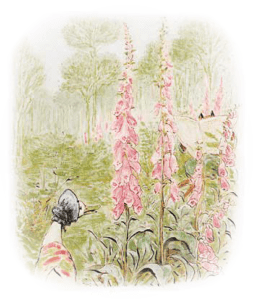
The house which the Potters rented for their summer holidays in Perthshire was surrounded by foxgloves and the young Beatrix painted some of these kenspeckle plants in one of her early sketchbooks. It was therefore no surprise that she revisited this favourite plant in Jemima Puddle-Duck, where spikes of tall foxgloves grow around the ‘summer residence’ of the crafty fox.
The hardy foxglove (Digitalis purpurea) grows throughout Scotland and has been used for centuries in traditional remedies, as well as featuring in Scottish folklore. This long history has given rise to a clanjamfrie of names for the plant in both Scots and Gaelic. Many of the Scots names are inspired by its shape and colour – some of them fairly gruesome, such as bluidy fingers and deid-man’s bells, as well as the more cheerful tod’s-mittens and witches’ thimmles. (The long finger-like shape of the flowers also lies behind its genus name, digitalis, from Latin digitus ‘finger’.) I decided to choose another traditional name, inspired by the association of foxgloves with the ‘wee folk’ – fairy-thimmles, meaning ‘fairy thimbles’. This name also echoes one of the Gaelic names for the foxglove, lus nam ban-sìth, which means ‘plant of the fairies’.
For anyone interested in the traditional names and uses of foxgloves and other native Scottish plants, I highly recommend two recent works by RBGE botanist, Dr Greg Kenicer: Scottish Plant Lore (2018) and Scottish Plant Names (2024). I have also used several Scots plant names in my short story, The Clootie Well, which I recorded for BBC Scotland in 2025.
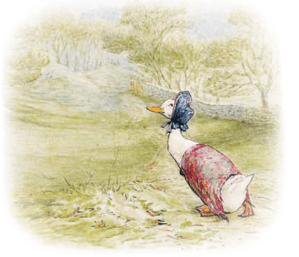
Paisley plaidie
In the original text, Jemima wears simply ‘a shawl’. But Beatrix Potter’s wonderful watercolour illustration clearly shows that it was of a traditional Paisley pattern. Paisley shawls came in a variety of shapes and sizes, including Paisley plaids which were intended for outdoor wear. Plaids are now associated with tweed or tartan wraps, but in the nineteenth century, they also came in Paisley patterns and were donned by women in both urban and rural settings. (See A. M. History & Romance of the Paisley Shawl, 1915.) The pleasing alliteration of Paisley plaidie was also a factor in deciding what Jennie should wear!
The Tale of Jennie Dubbie-Deuk is published by Edition Tintenfass in May 2026.

